
As a general rule, reversing is not allowed. However, there are some exceptions and in order to not avoid any legal infringement, you need to know what those exceptions are. It is useful to know and understand what the National Department of Traffic says on the matter and the current regulations.
For that reason, this article will tell you when you can and can’t drive backwards.
Cases in which reversing is allowed
Article 31 of the Traffic and Road Safety Law clearly indicates that it is prohibited to drive backwards unless exceptional circumstances arise. Some of these circumstances may be that you cannot change the direction of travel or that you cannot continue forward, as already stated.
- When you can’t go forward. For example, if you enter onto a road that has been blocked and cannot manoeuvre to turn around, you can reverse even if you travel more than 15 metres.
- When parking, starting or stopping. But you cannot reverse for more than 15 metres. Failing that, you should continue to drive to get back to that point. Nor can you enter onto a crossroads even if you travel less than 15 meters.
- When you cannot change direction.
- In the event that the direction of travel cannot be changed either.
- When complementary manoeuvres are performed. For example, when exiting a garage or reverse parking, but it is advisable to do it head-on.
What is the correct way to reverse?
Under any of these circumstances, the manoeuvre must be carried out slowly and warning others with the appropriate signals, so that it is performed in complete safety.
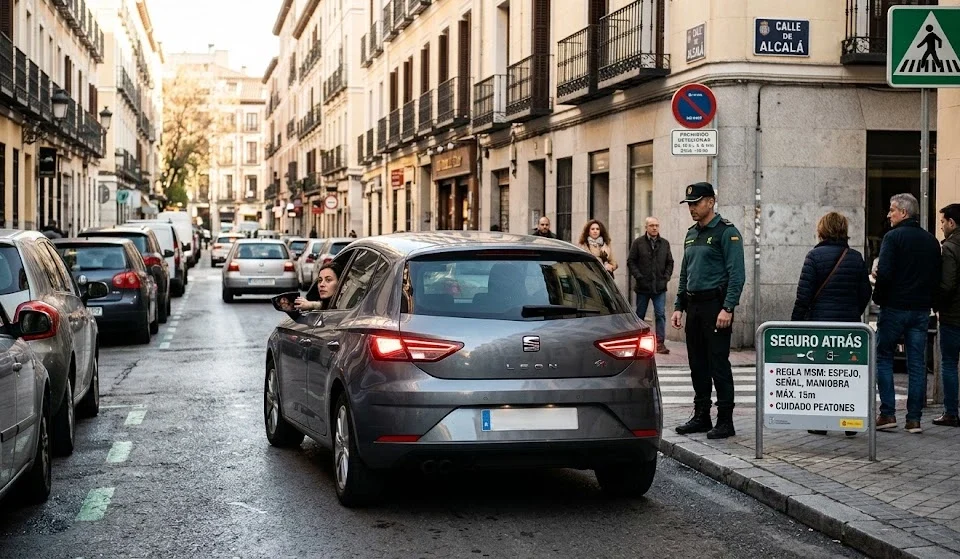
If you do not follow the rules listed, with the minimum viable route, you will be committing a serious offence. Therefore, it is advisable to use the MSM rule:
Mirror
It is essential to constantly check the mirrors. Proximity sensors and cameras are a great technological support that will show you an image of what is behind the car, so they facilitate control of the situation.
Signal
You must signal that the vehicle will reverse. You should always be aware of the minimum necessary route to do it. This is done automatically when the gearshift is engaged with the white taillights. If you are on an incline, do not move the vehicle without signaling.
Manoeuvre
This manoeuvre must be slow to allow for reaction time in the event of a possible unforeseen event. Remember that you must not compromise the road safety of other users. It is very important to do the manoeuvre with as much precaution as possible.
Can you reverse on the M-30
You already know that in article 31 of the Law mentioned above, it is forbidden to reverse except in very specific situations. In point number 3 it specifies that it is expressly forbidden to reverse on motorways and highways.
Therefore, being a ring road, with highway characteristics, it is forbidden to reverse on the M30. If you have missed an exit, you must continue until you find a direction change or until the next exit. Nor should you reverse on a roundabout.
Penalty for reversing
The sanctions foreseen for committing this type of offence involve a fine of 200 euros and the withdrawal of four points from the driver’s license. Reversing on this type of road is completely prohibited. Only firefighters, Civil Protection, Police, ambulances and the Civil Guard are allowed to reverse in exceptional cases, as long as they are performing an urgent service and confirm that this will not compromise the safety of any road user.
Ultimately, whenever you reverse you must do it slowly, ensuring you can do it without any danger to any other road user and use the mandatory signals.